

History of Springfield School
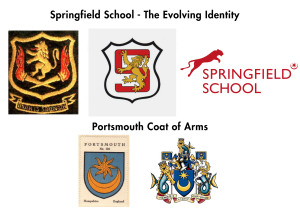
From Manor Court to Springfield: A History of Our School
For over sixty years, Springfield School has stood as a cornerstone of the Drayton and Farlington community. However, its story began not with the name we know today, but as a pioneering project born out of the growing needs of post-war Portsmouth.
The Birth of Manor Court
Before the current school site on Central Road was developed, local secondary education was provided by Court Lane School. By the late 1950s, Court Lane was severely overcrowded, due to the post-war growing population of families in the Portsmouth area. As Portsmouth expanded northward away from the heavily bombed historical dockyards and island core, suburbs like Drayton and Farlington experienced rapid residential growth. This forced the council to use temporary premises including Cosham Park House and the local Baptist Church hall.
To solve this issue, a 12-acre site off Grove Road - which had served as a Civil Defence area during World War II - was selected for a new ‘secondary modern’ school. It is believed that it was originally intended to be named Court Manor; however, the name was changed to Manor Court before opening.
The transition was gradual: Around September 1960 the first wing (Phase One) opened its doors. Half of the school’s 600 pupils moved into the new, ‘well-equipped’ block, while the other half remained at Court Lane. Early archives from the Evening News (1) reveal that the school's opening was met with mixed feelings. While the facilities were state-of-the-art, the first Headmaster, Mr RR Davies, campaigned for a bridge over the railway to help students from the Highbury Estate reach the school without expensive bus fares or long detours. (3)
The Transition to Springfield
As the UK moved toward a comprehensive education system in the late 1960s and early 1970s, the school underwent a significant transformation. The ‘Secondary Modern’ title was dropped, and the school was renamed Springfield School.
Local residents and former pupils on local history forums often recall this era as a turning point. While some felt the name change ‘air-brushed’ the Manor Court heritage, it signaled the school’s evolution into a modern comprehensive that would eventually serve over 1,000 pupils. (3)
Evolution and Modern Milestones
Over the years, Springfield has continuously adapted to meet the challenges of the changing educational landscape:
Specialist Status: (2) In the early 2000s, the school achieved Technology College status, which brought in additional funding to enhance STEM (Science, Technology, Engineering, and Maths) facilities.
Academy Transition: In April 2017, Springfield School, Solent Infant School and Solent Junior School came together to form a multi academy trust - The De Curci Trust.
The Future: Springfield is currently part of the Government’s School Rebuilding Programme and pupils are looking forward to moving into a brand new building during the autumn of 2027. The project, commissioned by the DfE and being delivered by Kier Construction, aims to ensure that Springfield continues to provide a cutting-edge learning environment for the next generation.
References:
(1) Portsmouth Evening News (16 September and 9 November 1960)
(2) Ofsted Inspection Report (Inspection number 279836)
(3) Drayton, Farlington and Cosham local history forums and alumni networks including Memories of Portsmouth and manorcourtupdate.blogspot.com
